butterfly

butterfly
summer 2013

Friday, March 7, 2014

INVASIVE PLANTS


Welcome to  Senegal, Tanzania, Denmark, Macedonia (FYROM), Puerto Rico, Argentina, Finland, Cameroon, Algeria, Belize, Guyana, Afghanistan, Monaco, Iraq, Uganda, Botswana,  and Barbados.


106 countries now viewing my blog.  Bewildering to me.  On a more confusing note,  I found my Paw Paw blossom picture on a Chinese website with a Chinese watermark on the image.  Found it flattering that my picture was good enough to steal :)

I know it has been a long time since my last post.  I am a very busy woman, and I had to catch up with Downton Abbey.


I usually have a yearly rant about planting native plants.  I encourage people to plant natives for the insects and birds, but it is just as important to ask people NOT to plant invasive plants. And, to remove invasive plants from their yard. Over time I have removed most of the plants considered invasive in our area.  There  are two in my yard that will be taken out in the next season or two.  Invasive plants will crowd out native plants, leaving less food and habitat for our birds and pollinators.


In our area of the country, you drive down highways lined with green, lush, cooling trees and plants.  Very pretty.  But if you look very closely, you can see clumps of trees and plants that really don't belong there.  Tree of Heaven (Ailanthus),  Olive trees, Bradford Pear, Japanese Honeysuckle, Wild grape, and multiflora rosa (wild rose bushes) to name a few.


Ailanthus and Honeysuckle

More Ailanthus (Tree of Heaven)


Recently, the common orange day lily (which I have always loved)  was listed as an invasive plant for our area.  I have already started removing some of what I  had planted.  It is hard work.  I use a pitchfork and shovel to dig it out of the ground.  Then I cut the top leaves off to compost and then cut the tubers off and throw them into the trash.  I know if I compost the tubers, they will just come back to life.


daylily


Since it was a favorite, I have quite a bit. I will remove most of it this year.


The good thing in this situation is that I HAVE to plant something new!  In my front walkway I have planted Black and Blue Salvia. Not a native, but not invasive. I had this in my backyard last year.  It is very impressive and it will attract hummingbirds:)


Black and Blue Salvia

Daily Visitor


New on the watch list in our area is the butterfly bush, Buddleia.  I have one in my yard that I will have my husband chainsaw to the ground.  I know this one will take a few years.  I may have to resort to roundup for this job.


I bought the butterfly bush many years ago.  I wanted to attract butterflies to my yard.  Little did I know (Pre Master Gardener Training) that the pesticides and herbicides that the lawn service was applying  pretty much killed all bug activity in our yard.  The note they left with the bill stated that there was evidence of grubs in our lawn.  Lawn looked great.  Soon there wasn't a bug, fly, beetle, butterfly, caterpillar or bird visiting my yard.  If I looked deeper, I may have found no earthworms either.


The next note stated that they sprayed for weeds and I should expect to see them die in the next week or so.  Sure enough,  the next week every zucchini plant, tomato and pepper plant was wilted and obviously dying.  Oh well.  Discontinued the service and let mother nature take over.  It took a few years for our yard to come to life again.


In our yard now there is life.  Caterpillars, bees, bugs, butterflies, worms, and birds have returned.


At the farm:


We have a big job ahead of us.  It seems that the banks of our creek are mostly held together with Honeysuckle bushes.  Invasive.   We bought  a lot of native trees and shrubs to slowly replace them.  We cannot tear them out because we think the erosion would be detrimental to the creek and surrounding land.  So, our plan is to cut the bush to the ground and immediately paint the stump with brush killer.  Then, plant a native tree or shrub a few feet away.   Our thought is that the new roots will establish as the old roots decay, holding the creek banks in place.  A huge undertaking and not always safe.  Slippery banks with a chainsaw.  Hmmm


Lined up, ready to plant


Native plants supply food to our birds and insects.  Below is one of my very favorites: Winterberry


My "Mini Meadow"

Can't wait for summer


Wednesday, April 10, 2013

MONARCH WAYSTATION

Welcome to:  Norway, Belgium, Mongolia, Bolivia, Haiti, Bulgaria, Venezuela, Malta, Mozambique, Bangladesh, Cote d'Ivoire, Ghana, Iran, Belarus, El Salvador, Panama, Saudi Arabia and Maldives!


89 Countries and counting!


Been gone for a while.  Lots of life got in the way last summer, and I pretty much had to abandon a lot of my gardening.


I did get to spend a little time in my yard at home and got to join a great club.  I am now a member of
MONARCHWATCH.ORG!


Last summer I had my yard certified as a Monarch Waystation.  This kind of yard provides the environment that is necessary for the Monarch Butterfly to reproduce and to stop and dine on their way to Mexico for their yearly migration.


Butterfly heaven


Host plants are necessary for the eggs and larva, but just as important are the late blooming nectar plants needed for their long journey.


Plants in the Milkweed family, Asclepias, are the only plants that the larva will eat.  Nothing else will sustain them.  Milkweed and butterfly weed  (not butterfly bush, buddleia) once upon a time were abundant in our area.  As houses started to take over the farmland and pastures, these plants were not considered beautiful enough to put into our home landscapes.


Flowers of butterfly weed - asclepias tuberosa

Monarch caterpillar on butterfly weed - Asclepias tuberosa


The butterfly will lay its eggs on the leaves of the plant.  When the egg hatches, about 3 days,  the larva hangs out on the plant and eats and eats and eats.  It will then start the pupa - chrysalis stage nearby.  That can happen on any branch or structure.   When the butterfly emerges, it can get its food from multiple sources.  Even non native plants, like the butterfly bush.


The butterfly has 3 generations per summer in our area.  They are short lived 2 - 6 weeks, so it is their goal to keep reproducing.  The last generation is long lived.  They will live up to 8 months and make a long trip to Mexico to winter and start their new brood for the next generation.


To become a way station, your yard needs host plants and nectar plants.  The organization has a list of plants needed, so all you have to do is check off the plants you have.   Butterflies also need water - they prefer puddles ( which I have plenty of in my back yard) and safe areas for the pupa (chrysalis) stage.  I have wood piles around my yard.  You email this information and are then certified and added to a registry.  When you are certified, you can elect to buy a metal sign to post in your yard.


The most striking thing about my yard is the huge variety of late blooming perennials.  When all the other flowers are fading and dying, these flowers burst to life. New England asters, goldenrod, obedient  plant, ironweed.  At the demonstration garden I work in, we have had people stop and get out of their cars to ask about our late blooming flowers. These plants are not available at the big box stores, so you really have to do research to know what you want,  then visit a nursery that specializes in native plants, or check out mail order nurseries.


helianthus

echinacea

helianthus

liatrus

milkweed - asclepias incarnata

rudbeckia

obediant plant - Physostegia virginiana

phlox

rudbeckia - black eyed susan

aster- blooms until hard frost   Cosmos and Dahlias also
aster

baptisia


Cool stuff:


Cicada Killer


First asparagus in my first asparagus crop!


Sunday, July 8, 2012

GARLIC


Welcome to Georgia!  71 countries.


Big news from Thurmont!   My daughter and her husband have bought a house in another part of the county.  We are so  happy for them, but  we now have to find a renter for our farmhouse.  Our plan is to rent the house for a year or two and then we will probably move up to the farm permanently.  My stipulation is:  I want a master suite addition on the back of the house with a walk in closet and a mudroom.  My plan is to grow old in this house and I want everything on one level.

Inside, the house has a new bathroom and kitchen and oak staircase to the second floor.  A new heating and air system will be installed this month so there will be no need for window units.

If you are interested in renting, email me at lizzygold100@yahoo.com   I'll even include one of the garden beds for your use:)


Last fall I planted garlic in my raised beds.  The year before I plant a soft neck variety.  I guess it wasn't ideal for our area.  I did get garlic bulbs.  Small.  Not worth saving in my opinion.

I did some research and found that a hard neck garlic does best in our area.  I put my order into Territorial Seeds and followed the instructions.  It is amazing what happens when you actually follow directions.  I am sooo pleased with my garlic crop!


Soft neck varieties do better in milder regions and are supposed to store better than hard neck.  I think that my garden is in a harsh micro climate.  We are a few miles south of the Mason Dixon Line, so we are technically in the South.  I plant later in this garden than my home garden 10  miles south because I have been hit with late frosts in the farm garden in Thurmont, and not in my home garden.


Cloves from territorial Planted in the fall

April
garlic scape


after scapes were cut


You need to remove the scapes - the flower heads that emerge to produce seeds.   You want all the plant's energy to go to bulb production, not flower and seed production.


The scapes can be used for cooking.  They look a little like scallions, but taste just like garlic.  They can be sauteed whole or cut up and added to your food. Just like garlic.


I still have a bag in my fridge - they are holding up nicely.


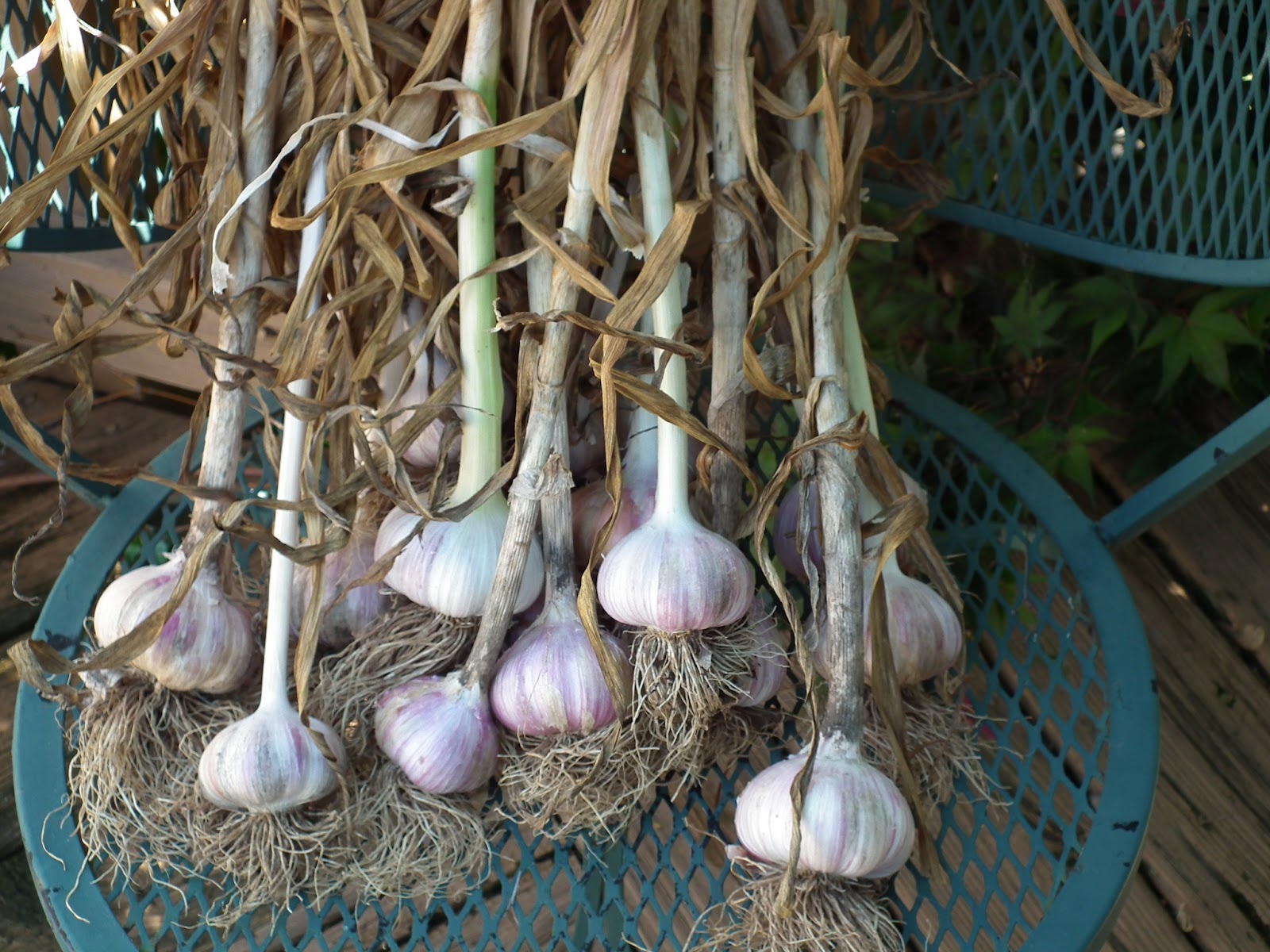
Everything I have read states you can harvest your garlic when the bottom 2 leaves start to die.  I came to the garden and the whole plant was dried and brown.  oh well.  It still looks great.


pulled from bed


I gently used a pitch fork to remove the bulbs from the dirt.  I did not want to injure the plants.

I have read instructions to just gently brush extra dirt from the bulbs, and other instructions to remove a layer or 2 to have cleaner garlic bulbs.  All the the instructions tell us to cure the bulbs so they store better,  about 3 weeks in a cool, protected, well ventilated, dry area.   My barn is full of hay, my shed doesn't have moving air, and I don't want my house to smell strongly of garlic for the summer.  So,  I found a protected area under my deck.  Unless we have a deluge of rain, I can't imagine they will get soaking wet.  There is excellent air circulation under there also.


getting ready to clean - used a soft brush to remove excess dirt.

pulled off a layer

Half have layer removed, other half left on

curing under deck


I will see which way lasts longer.  After garlic is cured it should keep  6 to 8 months.  The only problem I may have is that we are in the middle of a horrific heat wave.  100 degrees every day for over a week now.  We shall see!


Hazy day (month) in Northern Maryland

Saturday, June 23, 2012

WHAT HAPPENED TO MY PLANTS?

Welcome to Cambodia, Moldova, Slovenia, Mexico, Switzerland, Brunei and Saudi Arabia!

70 countries, 6 continents!


Well!   I came home from work one day last week and noticed that the outside of my house was sparkling clean.   Looked great!

My husband informed me that he called "a guy"  to come and pressure wash the house.  Really, it was beautiful.  Before the guy came, the north and east sides of the house were a tad green and full of cobwebs and God knows what else.


A few days later I noticed that the white impatiens I planted out front were a little pale and peaked looking. I mean the leaves were turning yellow and falling off and the stems were withering. It then occurred to ask Mike, "Hey Mike,  did 'the guy' use any chemicals on the house?"  He answered " a very mild soap, and a small amount of bleach."   Hmmmm.


Well, I didn't have high hopes, but I gave the plants a chance to try to recover before I yanked them.  Another concern was, will anything I grow there survive?    The dusty miller and allysum  look fine, the well established shrubs look great too.


No dice.  Went to my favorite nursery  Dutch Plant Farm  in Frederick to find replacements.  Late June - very slim pickins.   Wal Mart had white impatiens  but they are not a nursery so great care is not taken with plants late in the planting season.  What they had for sale didn't look much better than my dying plants.    Found some mixed coleus in very good shape at Dutch Plant Farm and they were deeply discounted.  They were already in flower, but I took care of that.  I clipped the tops off to a node lower down.


I am leaving the impatiens, but I cut them back quite a bit.   If they don't survive, the coleus will cover the skeletons.


Sister plant in another part of yard

Damaged plant

Signs of new growth

Coleus added to bed to fill in and hide


A lot of things can harm plants:  Chemicals, String trimmers, pollution, heat, cold, ice, animals, drought - just to name a few.


Using a spray herbicide can do a lot of damage on a windy day.  The spray can drift and you may not be aware if it.   I have done delicate weed removal in one the the penstemon beds at the demonstration garden.  Bermuda grass cannot be pulled up, one piece of rhizome will turn into a whole plant very quickly.   I took a sponge paint brush and applied the Round Up to the bermuda grass very carefully, by placing the grass on a piece of newspaper and "painting" the grass.  Worked great, tedious, but effective.


String trimmers on  shrubs and trees can damage the vascular system and harm the plant's ability to transfer water and nutrients.


Pollution can be very hard on trees and plants.  In the 1970's  I went to the USDA building in Beltsville, MD.  My father was taking a botany class and he invited me - I was about 14 or so.  I have vivid memories of the instructor telling us about the damage done to trees from the exhaust of our cars.  On the way home, I could see with my own eyes the yellowed and sickly trees along RT 495 - the Washington DC beltway.  Keep in mind, this was before leaded gasoline was banned.

On a much happier note:  here are pictures from that last 4 weeks or so.


perennials


garlic

Huge strawberry crop

Future gardener - check out the shovel

4 generations hanging out on father's day

New addition to the farm - 1 day old

Utica bridge.  We have 3 covered bridges in Frederick County


Dirty face again.  One of my garden pests

Boy do I love summer :)